


My thesis: the strongest product teams are not made up of people who only do exactly what is written in their job description. They are made up of specialists who take responsibility, recognize complexity, make decisions under uncertainty and acquire missing capabilities when the shared mission requires it.
Comparing product teams with Navy SEALs and other special operations units can sound martial. The boundary of the analogy therefore matters: this is not about combat, military hierarchy or romanticizing dangerous operations. What interests me are the organizational principles behind small, highly specialized teams that must operate with incomplete information, manage dependencies, identify risk early and still deliver reliably.
Product organizations face a much less dramatic version of the same structural challenge every day. Requirements change. Data is incomplete. A technical assumption turns out to be wrong. The deadline still exists. A regulatory issue appears. A key expert is unavailable. The product becomes more complex than the original concept suggested.
So the interesting question is not primarily what special operations units can do, but how they build teams, organize learning and distribute responsibility. The official U.S. Navy page currently describes 62 weeks of initial SEAL training followed by another 18 months of pre-deployment and intensive specialized training. The official SEAL Ethos includes phrases such as “We expect to lead and be led” and “My training is never complete.” Initiative, technical skill, innovation and attention to detail are explicitly part of the model.
The idea in 30 seconds
- Not everyone needs to know everything. But the team as a whole must remain capable of acting.
- Mission beats job description. Goals, risks and success criteria matter more than handoffs between roles.
- Learning ability is a core capability. A missing skill should not automatically create a permanent dependency.
- Reliability is part of product quality. Strong teams do not just generate ideas; they deliver outcomes dependably.
- Complexity is actively explored. Good teams see the system, not only the happy path.
Deep expertise in a discipline remains essential.
The team understands enough across disciplines not to fail at role boundaries.
The decisive question is not who owns the task, but whether the problem gets solved.
1. Not generalists: adaptive specialists
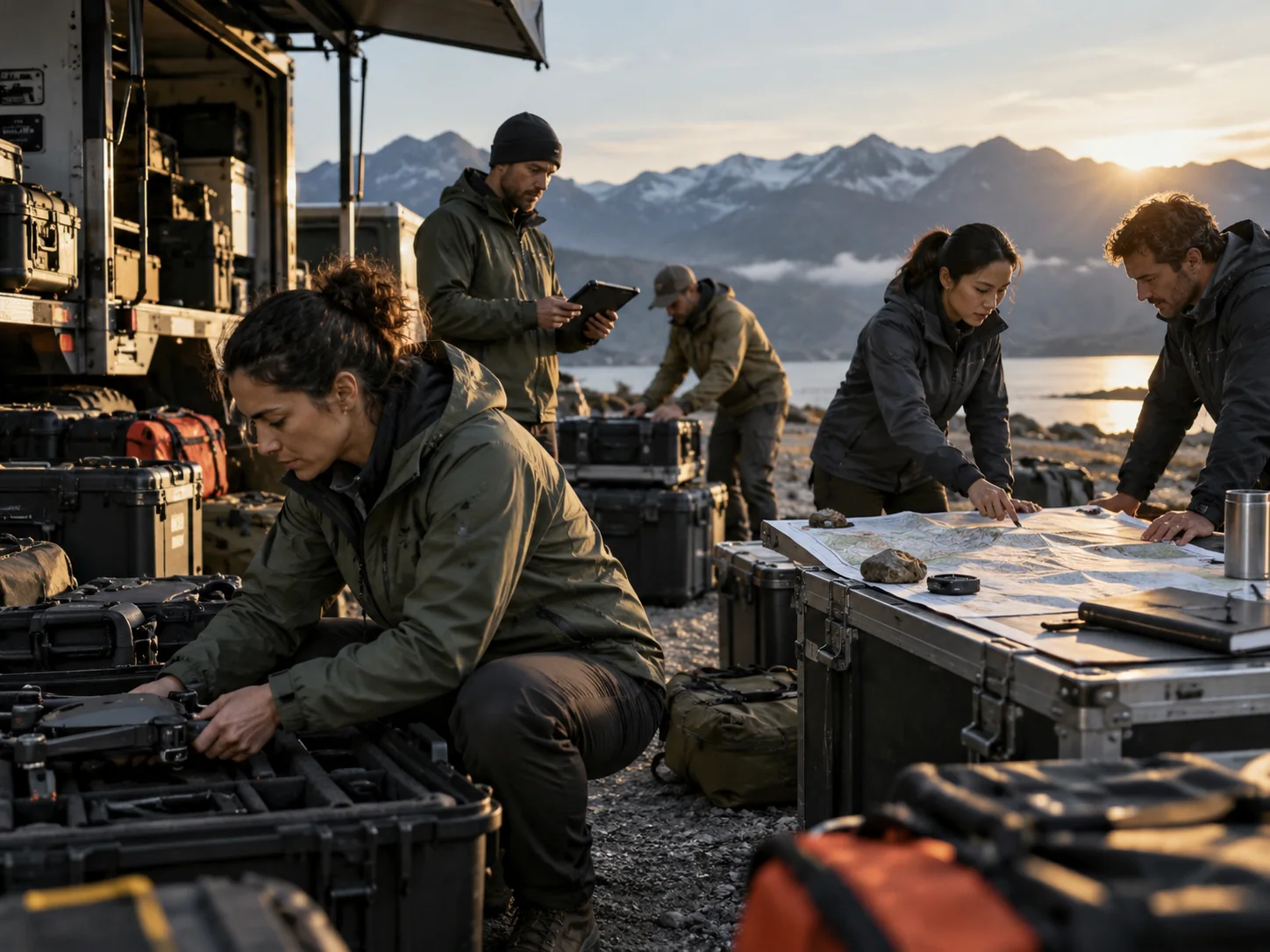
A common misunderstanding is that members of special operations units somehow know how to do everything. That is not the point. They have deep specializations, different responsibilities and people with far more experience in specific disciplines. What matters is something else: specialization must not create organizational helplessness.
A highly capable team cannot collapse simply because the one person with the perfect job title is not available. The same should be true of digital product teams. Yet many organizations still look something like this:
- Product understands the problem but can barely assess the technical consequences.
- Engineering understands architecture and code but only part of the customer problem.
- UX understands the user flow but has limited visibility into revenue models, product KPIs or technical constraints.
- Analytics owns the data but sits elsewhere in the organization.
- Security, Legal or Operations are involved shortly before release.
The organization has many specialists, but the product team itself is not fully capable of acting.
A strong cross-functional team works differently. The engineer does not have to become a UX designer. The designer does not have to build a production-grade backend service. The Product Manager does not have to become a Data Engineer. But all of them should understand enough of the adjacent disciplines to make better decisions together.
What a strong Product Designer should understand beyond design
- Business: Which metric should change? Where is economic value created?
- Engineering: What does an interaction imply for the data model, performance or technical complexity?
- Product: What problem are we actually solving, and for whom?
- Analytics: How will we know whether the solution works?
- Operations: What happens beyond the ideal happy path?
This breadth does not replace specialization. It makes specialization more effective.
That is the useful limitation of the analogy. An autonomous product team does not need to do everything itself. It needs to know: What can we do? What can we learn quickly? When do we need help? And from whom?
Team Topologies describes a similar principle. Stream-aligned teams aim to deliver as much value end to end as possible. When a capability is missing, enabling teams can help build that capability without turning every knowledge gap into a permanent handoff or organizational dependency.
Cross-functionality therefore does not mean: everyone can do everything. It means: the team can accomplish the mission.
2. Mission before job description

Special operations units cannot have a detailed playbook for every possible situation. Reality changes faster than the plan. A core capability is therefore to understand the real objective and make decisions within clear boundaries.
The SEAL Ethos states this unusually directly: in the absence of orders, people are expected to take charge, lead teammates and accomplish the mission. At the same time, every team member is expected to lead and be led.
Translated into product development: a team needs more than tickets. It needs intent.
“Build a filter with five categories.”
“Users with large result sets take too long to find relevant products.”
“We measurably reduce the time to a useful selection.”
With the first instruction, a team can mainly execute. With the second and third, it can think. A filter may be right. Better search may be better. Smarter defaults may solve more. The real issue may even be poor product data rather than the interface.
A team can only make good autonomous decisions when it understands four things:
- which user or business problem needs to be solved,
- which constraints and risks apply,
- which decisions the team is empowered to make,
- and how impact will be measured.
This aligns closely with Google's Project Aristotle. Beyond psychological safety, Google identified Dependability, Structure & Clarity, Meaning and Impact as key dynamics of effective teams. People need to know more than what to do; they need to understand expectations, the decision process and how their work contributes to a larger result.
5Psychological Safety · Dependability · Structure & Clarity · Meaning · Impact
Many companies talk about empowerment while decisions still have to escalate through several layers. The result is simulated autonomy: the team may choose the UI treatment, but cannot influence scope, priority, solution direction or success criteria.
DORA describes high-performing software organizations more rigorously. Teams should be able to make substantial changes, test and release their product without constant fine-grained coordination or permission from other teams.
For product organizations, the formula is simple: mission clear. Boundaries clear. Decision rights clear. Then move.
3. The real superpower is learning ability

What happens when a project suddenly requires a capability nobody on the team currently has at the necessary level?
The classic enterprise answer is often: request a resource. Then come capacity planning, budget, prioritization, department heads, a kick-off, a briefing and a handoff. Weeks later the team may finally have access to the right person.
An adaptive team asks another question first: Can we build enough of this capability ourselves, fast enough?
This is where the SEAL Ethos becomes especially interesting for product organizations. Training is explicitly treated as never complete. The official Navy page describes 62 weeks of initial training, followed by another 18 months of pre-deployment and intensive specialized preparation. The model is not built around static knowledge; it assumes continuous development.
In a product team this can be very practical:
- A designer learns to read simple SQL queries or analytics events.
- A Product Manager inspects an API response in browser DevTools.
- An engineer joins user interviews and watches real workflows.
- A UX Researcher learns to explore funnel and retention data directly.
- A Product Designer uses AI or low-code to build a functional test instead of only a clickable screen.
- An Engineering Lead spends time with support and sees what actually happens after release.
Not because everyone should end up with the same role. The point is to increase the team's collective problem-solving capacity.
AI accelerates this shift. Discipline boundaries do not disappear, but they become more permeable. Designers can build functional prototypes faster. Product Managers can explore data or create small automations. Engineers can test UX or content variations more quickly.
The most valuable person on a team is therefore not necessarily the person with the largest static inventory of knowledge. Often it is the person combining deep core expertise, learning speed, analytical thinking, curiosity, ownership, judgment and collaboration.
That also changes recruiting. The question is no longer only: “Does this person know tool X?” It also becomes: “How does this person respond to a problem they do not yet know how to solve?”
4. Reliability beats brilliance

Another misunderstanding about high-performing teams is the idea of the brilliant individual hero: the rockstar developer, the design genius, the visionary product leader. In critical situations, a less glamorous quality is often more valuable: reliability.
Google explicitly lists Dependability among the five dynamics of effective teams: people reliably complete quality work on time. It sounds obvious. In practice, it is not.
Product organizations lose huge amounts of energy through sentences like:
- “I thought someone else was doing that.”
- “The backend is done, but nobody knew mobile was still missing.”
- “We'll add analytics later.”
- “We didn't test what happens when the request fails.”
- “The design only works with perfect data.”
- “Legal hasn't seen it yet.”
- “We'll deploy next week because nobody from DevOps is available today.”
A high-performance team therefore treats delivery as a system, not as the final stage after discovery and design.
Reliability questions worth answering before release
- What can realistically fail?
- Which assumptions are we making?
- Which dependencies sit outside the team?
- Who decides when trade-offs conflict?
- How will we detect problems in production?
- How can we roll back or correct the change?
- Who can take over if a key person is unavailable?
- What happens after release: support, analytics, optimization?
This has little to do with heroism. It is discipline. One of the SOF Truths makes the same point: capable special operations forces cannot be created after an emergency occurs. Readiness has to exist before the crisis.
#4Competent Special Operations Forces cannot be created after emergencies occur.For product teams: resilience, delivery routines and ownership must exist before things go wrong.USSOCOM ↗
Product organizations often discover this during their first serious incident: a production outage, security issue, unexpected usage spike, broken migration, regulatory problem or unavailable dependency. That is when you find out whether the group is really a team or simply a collection of specialists sharing a Jira board.
DORA recommends working in small batches. Small changes shorten feedback loops, make course correction easier and reduce the risk associated with large, difficult-to-reverse releases.
The principle is not: never make mistakes. It is: detect mistakes early, limit their impact and recover quickly.
5. See complexity before it becomes a problem

An exceptional team is not only good at solving problems. It detects problems early. In product work, I would call this Product Situational Awareness.
A feature can look trivial at first: “We need a Delete Account button.” A strong team immediately sees additional layers:
- What happens to open transactions, invoices or active contracts?
- Which personal data must be deleted, and which must legally be retained?
- What happens in backups and connected systems?
- Do we require re-authentication?
- Can the action be reversed?
- What happens if only half of the connected systems complete the deletion?
- Which support and audit processes depend on this action?
The same applies to a supposedly simple filter. What is the quality of the underlying attributes? Which filters depend on each other? What happens with zero results? How does it behave on mobile? Is it accessible? How will usage be measured? How does localization affect it? What happens under poor performance?
An average team sees the screen. A strong team sees the system.
Where do cognitive load, misinterpretation, dead ends or trust problems emerge?
Which dependencies, data issues or performance risks sit behind the interface?
Which risks matter commercially, and which trade-offs do we consciously accept?
Then add Data: how will we know a problem exists, and how often it occurs? Only by combining these perspectives do we get a more complete operational picture.
The goal is explicitly not to solve every imaginable edge case before starting. That would be analysis paralysis. Strong teams instead distinguish between three categories:
This capability becomes more important as product complexity grows: payments, healthcare, AI, enterprise software, identity, fintech and marketplaces. In these environments, happy-path design is not enough. Product quality increasingly reveals itself in edge cases, dependencies and how the system responds when reality does not follow the plan.
6. How to build a “Special Operations” product team

The key lesson from the analogy is not to make product teams work harder. Quite the opposite. It is to design organizations so that good people can act effectively.
USSOCOM expresses this clearly in the first SOF Truth: “Humans are more important than hardware.” Tools cannot compensate for a weak team. The same is true in product development.
Figma does not create a good design team. Jira does not create good Product Management. GitHub does not create a good engineering team. AI does not create a good product organization. People, responsibilities and the shared operating model decide.
Nine principles for an adaptive product team
- Small, stable, cross-functional teams: Product, UX and Engineering work together continuously rather than acting as rotating service providers.
- Deep specialists with broad system understanding: everyone owns a core discipline but understands enough of the whole to avoid isolated decisions.
- Mission instead of ticket factory: teams receive problems, goals, KPIs and constraints rather than only predefined solutions.
- Learning is part of the work: missing capabilities do not automatically trigger another handoff or permanent role.
- Decisions close to the problem: people with the best context should be able to decide within clear boundaries.
- Delivery is shared responsibility: Design does not “hand off” to Engineering. The team delivers an outcome together.
- Risk is actively searched for: security, accessibility, privacy, edge cases and operational consequences belong to product work.
- Failure creates learning: psychological safety, open reviews and the ability to surface bad news early are essential.
- External specialists strengthen the team: Security, Legal, Research or platform teams enable the product team without permanently centralizing every decision.
Psychological safety is not a soft culture topic. If people are afraid to surface a wrong assumption, a bug or an emerging risk, the team does not become safer; it becomes blind. That is why Psychological Safety was the leading dynamic in Google's Project Aristotle findings.
Leadership changes in this model as well. Strong team leadership does not mean making every decision personally. It creates context, sets quality standards, develops people and ensures that responsibility can genuinely be taken. Mentoring becomes a scaling strategy: the more people on the team can make good decisions independently, the less leadership becomes the bottleneck.

The goal is not a team that can do everything. That would be neither realistic nor useful.
The goal is a team that does not become helpless when an unexpected problem appears. A team that can say:
- We understand the problem.
- We know what we do not know yet.
- We can acquire missing knowledge.
- We identify risk early.
- We know when we need specialists.
- We make decisions.
- And we deliver.
Perhaps that is the most useful idea in the comparison with special operations. Their strength is not having the perfect capability for every imaginable scenario in advance. Their strength is combining people, training, responsibility and collaboration so the team continues to function when the original plan no longer does.
That is what modern product organizations need as well: not always larger departments, more roles or more tools, but small, capable teams across Product, Engineering and UX that truly own a shared problem.
Specialists in their discipline. Generalists in their thinking. Experts at adapting.
Sources & further reading