A multi-brand B2B platform for global foodservice leaders.
An international B2B multi-brand platform used by leading foodservice companies worldwide for their procurement. Nine years of product work on complex assortments, global ordering processes and a clear user experience.
A platform for global procurement.
Those who order for a restaurant are not just looking for a product. Decisive are the right range, reliable availability, delivery information and the assignment to the right branch. Recurring orders, customer-specific catalogues and existing company processes make the task much more extensive than a classic webshop.
The previous platform had grown over more than 15 years. It was to be redesigned as a responsive application while maintaining its connection to ERP, inventory and international operations. It was about a new user guidance and a viable basis for continuous product development.
From the common direction to the delivered product.
My contribution combined product thinking, UX architecture, design quality and practical front-end implementation. I conducted workshops, structured requirements and coordinated work with the US project team and technical contacts. In the course of the cooperation, this also included the alignment with IT and later global e-commerce responsibility.
At Ventzke Media, I put together the design and development team and accompanied the collaboration across disciplines. I connected the overarching product direction with concrete decisions on interactions, components and releases.
Strategic level
Clarify issues and priorities, classify requirements, and enable consistent product experience across market and brand boundaries.
Practical level
Accompanying journeys, wireframes and prototypes, checking designs, coordinating implementation with engineering and tracking quality into the build.
It started on a wall.
In the kick-off 2017, we mapped the future platform together. Start and login, dashboard, catalogs, search, account, shopping cart and checkout became visible as a coherent structure. This created the basis for more than 100 individual views.
Particularly important were the B2B-specific processes: branches with budgets and attachments, open orders, automatic deliveries, invoices, credit notes and order templates. Only this perspective made clear which decisions belong together and which dependencies a gradual implementation must take into account.
Eight tasks. Concrete solutions.
From the first orientation to working on branch projects: The following insights show central developments of the platform. For each topic, an original product screen and the most important decisions are the focus.
Platform relaunch
- A platform that has grown over the years is redesigned as a responsive B2B application.
- More than 100 individual views designed for catalogue, search, account and ordering processes.
- React and TypeScript frontend connected to existing ERP and international stockpiles.
- After the first release, further countries were introduced gradually.
Search and Filters
- Filter positioned above the results and thus made visible as the next step.
- Selection on the desktop applied directly to the product list.
- Equipment, spare parts and small parts are made available as different product types.
- Active selection and reset displayed comprehensibly; mobile filters designed with their own confirmation step.
Shopping cart and checkout
- Store selection and delivery context integrated into the ordering process.
- Address, shipping and payment organized in a one-page checkout with accordions.
- Supports recurring procurement via watchlists and the transition to the shopping cart.
- On smartphones order amount and final promotion also kept visible when scrolling.
Notification Centre
- Notifications made directly to sold out products can be activated.
- Active status, runtime, and removal of a reminder are clearly displayed.
- All reminders are bundled in an overview with product data and availability.
- Activation, feedback, profile navigation and mobile use are designed as a coherent process.
Project overview
- Projects and branch locations connected in a switchable map and list view.
- Search by project, order, store address and date, as well as filter for status and package type supplements.
- Offers, orders, attachments and images within a project via accordions.
- Contact person and a project gallery with download function integrated into the workflow.
Accessibility
- More than 300 documented accessibility issues have been addressed during further development.
- The project goal WCAG 2.1 is achieved.
- UX architecture, design quality and front-end implementation are closely aligned.
- Testing of the actual application is integrated into the ongoing quality assurance.
AI-based development
- Claude Code and Codex for code generation and testing used in recent development.
- Around 95% of the code in the described development phase is written and tested with AI.
- Around 70% lower development time compared to the previous workflow as an internal experience value.
- Maintain four-eye reviews, automated tests, end-to-end exams and accessibility checks as quality rules.
From the search result to the matching spare part.
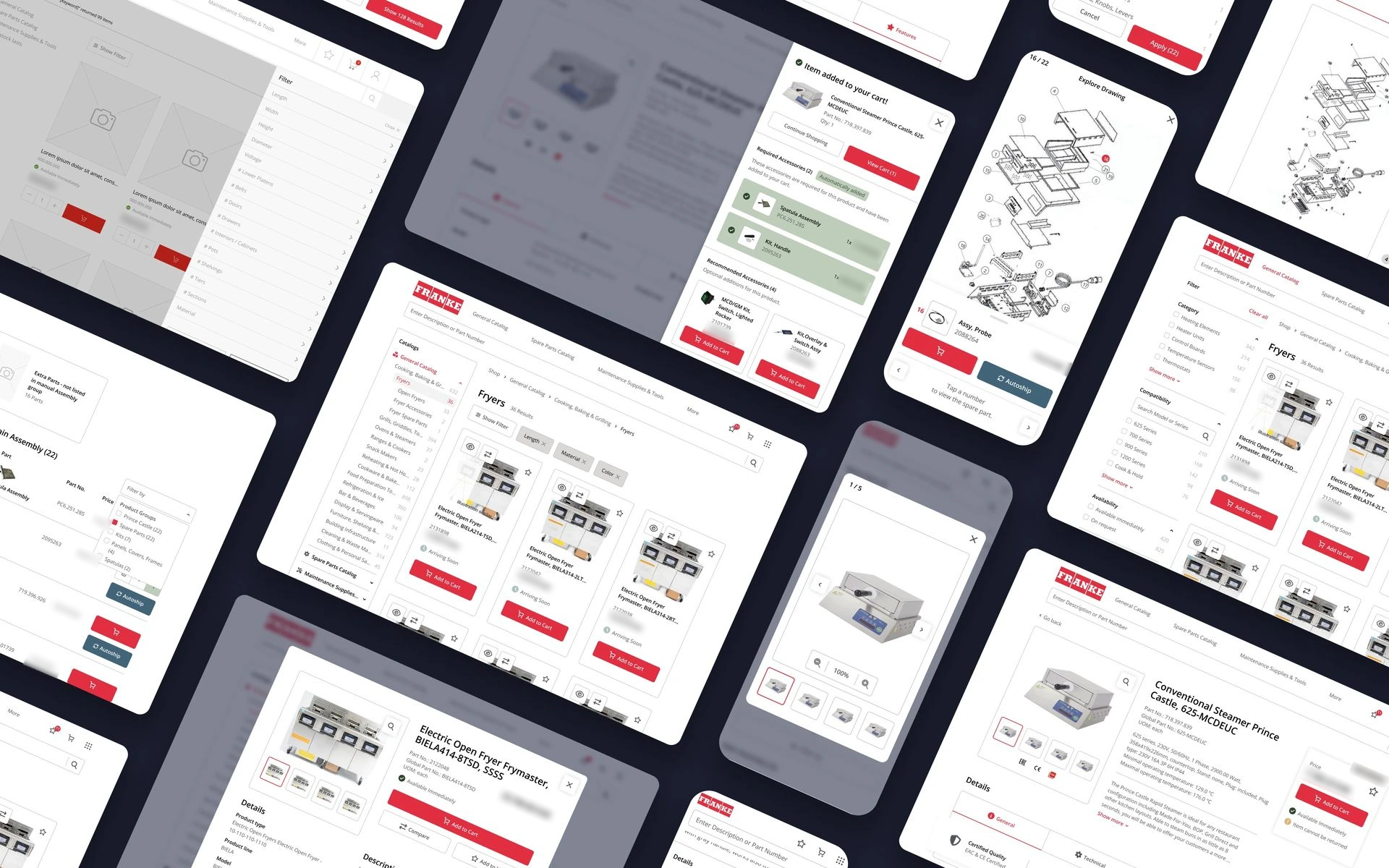
The Figma designs for further development show how products in the B2B catalogue can be narrowed down and tested more quickly. Technical filters restrict the hits based on measurements. The quick view shows central product data and allows articles to be earmarked directly for comparison.
On the detailed page, the article number, availability and technical information are in the same context. When added to the shopping cart, the design shows which accessories are required and which additions are recommended.
On the smartphone, spare parts can be filtered by product groups or identified via a position number in the exploded drawing.
International voting. Continuous delivery.
The design, frontend and backend were coordinated across country and time zone boundaries. The UX and design work ran in overlapping iterations: While shared views were implemented, the concept for the next areas was already created. Thus, the relaunch became a continuous development process.
After the first release in German-speaking countries, other countries followed. Instead of seeing the platform as a completed project, we developed it over the years: new requirements, different usage contexts, technical updates and recurring improvements in user experience.
Common quality
Design reviews prior to delivery, reusable components and acceptances to the actual application combine design and engineering.
Comprehensible decisions
Workshops, structured coordination and visible priorities keep cooperation with international stakeholders capable of acting.
Accompanying a product over several years.
- 2017 / Workshops, prototyping and UX conceptJoint workshops laid the foundation for information architecture, user experience and the new product interface.
- 2018 / Iterative launch of the new webshopThe new platform was gradually introduced and subsequently rolled out internationally.
- 2019 / Continuous Delivery and Platform ExpansionThe cooperation went from relaunch to a continuous further development of the B2B platform.
- 2020 / Platform expansion and update on React 17The technical basis was updated on React 17 and the platform was further expanded functionally.
- 2021 / UX for the Asian marketThe user experience was revised for the Asian market and adapted to the extended international use.
- 2022–2023 / New functions and continuous developmentNew requirements and features were integrated into the platform during ongoing operation.
- 2024 / Search and filters further developedThe filters in the product catalogue have been revised in order to narrow down large amounts of results more precisely and to find relevant products more easily.
- 2025 / Implementation of WCAG 2.1Accessibility has been systematically implemented: more than 300 documented problems have been addressed and the project goal WCAG 2.1 has been achieved.
A platform that can grow.
The platform connects more than 20,000 products, 20 languages and cross-brand procurement processes. More than 100 individual views have been edited in the design scope. In the course of accessibility work, more than 300 documented problems were solved and the project goal WCAG 2.1 was achieved.
The key contribution is related: clear product paths, a common system for design and frontend as well as more than nine years of viable cooperation. Individual functions were placed within this framework and continuously developed.