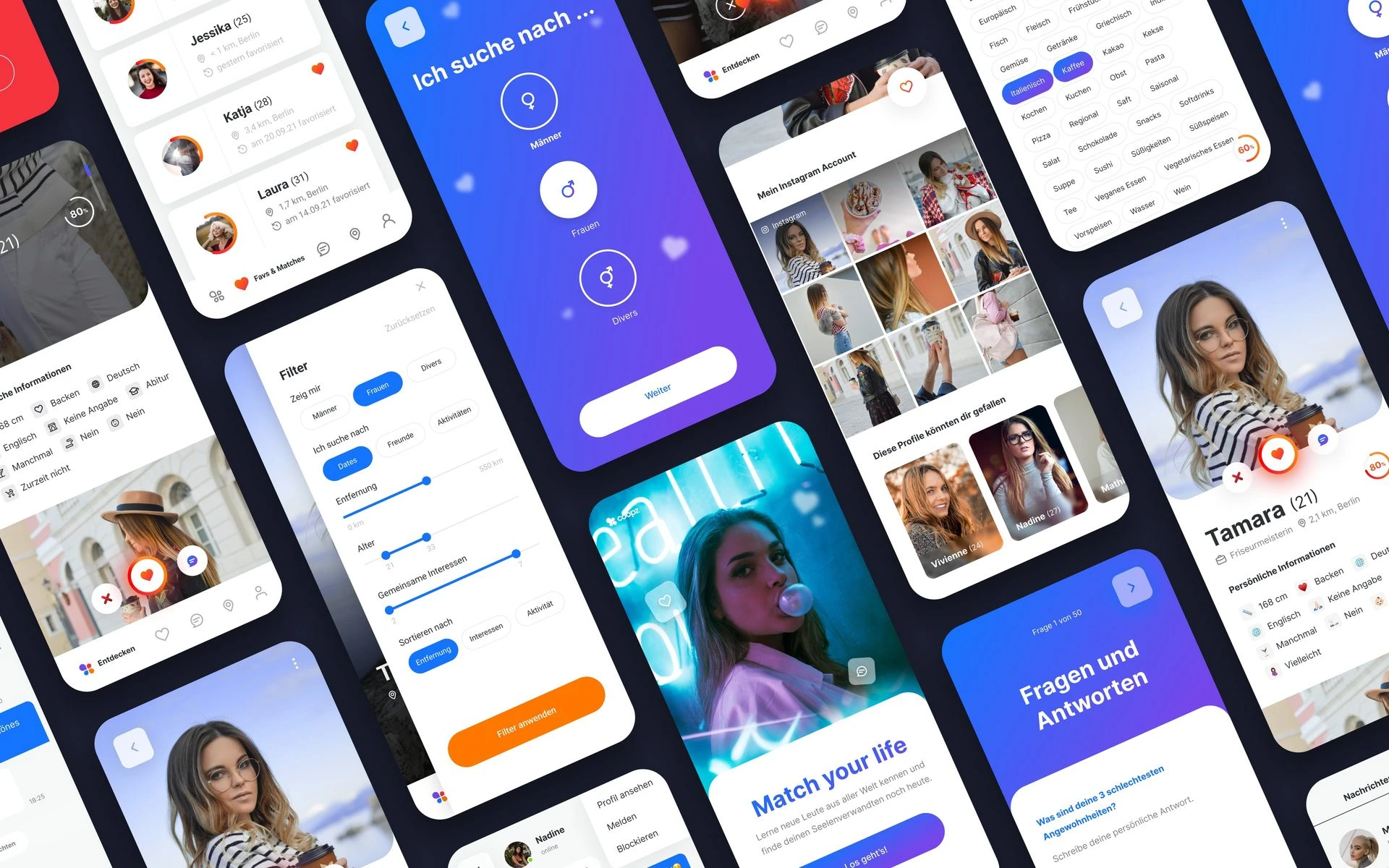
Building an international dating app with over 100,000 registered users.
A product of its own makes every decision immediately: positioning, user experience, development and growth must fit together. At coopz, we’ve shaped this path from the first MVP to the more advanced social dating app.
Common ground as a starting point.
coopz connects people across interests, intentions and places. This resulted in a product idea in which the first impression was to be combined with a deeper understanding of commonalities. The entire experience had to be coherent from the brand to the first entertainment.
As its own product, coopz was also a practical learning field for end-to-end product development. We were able to directly try out new ideas, observe their impact on usage and further develop the application in several iterations.
Keeping a product together from the beginning.
I designed product vision and positioning and connected them to brand, onboarding, matching and activation. Work was done closely with design, engineering and QA. Part of my responsibility was to translate the different parts into a traceable product development.
This view influenced the order of the questions in onboarding, the presentation of suitable profiles and the paths to a conversation. Later iterations also focused on notifications and control over incoming contact attempts.
Ask questions that make a difference later.
The onboarding had to learn enough about one person to enable relevant suggestions. At the same time, the amount of questions should not unnecessarily make it difficult to get started. Profile details, pictures, interests and search preferences therefore had to be queried in a dosed and comprehensible manner.
Common interests, age, height, gender and languages flowed into the matching. The application made the calculated match on profiles visible. This gave users an additional clue as to why a proposal might be relevant.
Controlling the amount of information
The first steps will focus on information that is important for the start and the proposals. Profiles can be supplemented and changed later.
Connecting the benefits
The effort in onboarding must continue in a meaningful next experience: relevant profiles and a clear path to contact.
The match is a transition. No end point.
If two people like each other, an overlay signals the match. The next decision is deliberately simple: start a conversation or discover more profiles. Anyone who misses the event will see the information the next time the app is opened.
Favored places complemented interest-based discovery. For example, people could store parks, museums, restaurants or cinemas and see people in their surroundings. This area followed its own logic; it showed people in close proximity, regardless of the matching indicator.
Relevance does not end after registration.
In the further course of the product, notifications and the handling of incoming contacts became a focus. For a social app, it is not enough to send as many hints as possible. What matters is whether they make a relevant connection visible and people retain control over their contacts.
The brand, onboarding and core interactions were comprehensively revised in the course of coopz 2.0. The redesign scope was about 100 screens. This breadth made a consistent system particularly important for states, navigation and recurring patterns.
From MVP to two platforms to the next version.
- 2016 / MVPThe first version translated product idea and central interactions into a usable application.
- 2018 / AndroidExpansion of the native Android application and its market launch.
- 2019 / iOSExpansion to the second mobile platform.
- 2020 / coopz 2.0A major overhaul of branding, onboarding and product experience.
An app is an ongoing learning process.
coopz reached more than 100,000 registered users. In the course of the product, the number of daily active users increased by 250 percent. In addition, there was a top 3 placement on Google Play for the search term “dating app”. This information describes the product history; it is not attributed to a single design change.
The most important experience was the combination of product responsibility and daily use. Own products very quickly show where a concept wears in everyday life and where friction arises. This learning has shaped my view of activation, prioritization and the quality of real product experiences.