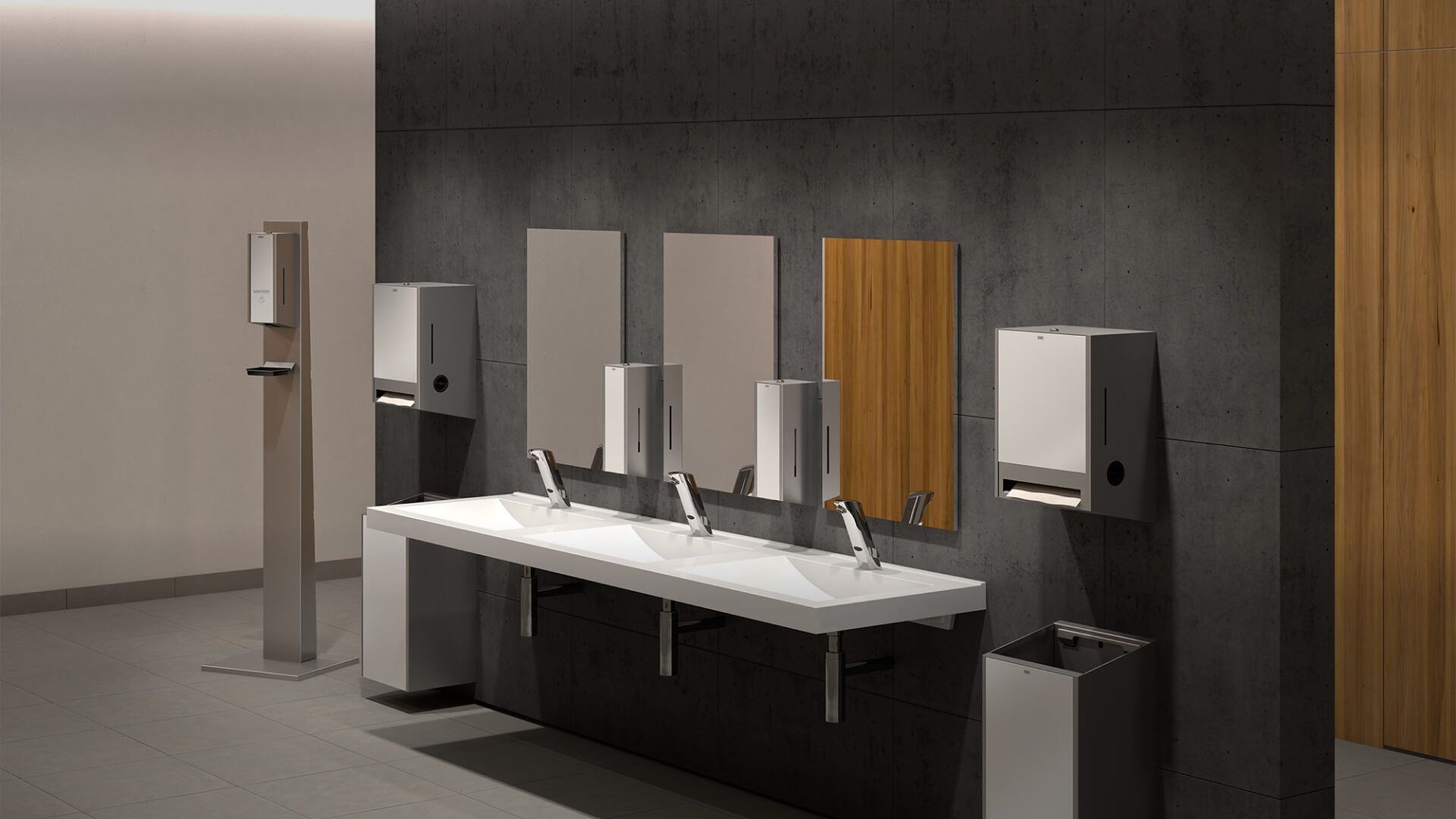
Configuring complex washroom products in 3D, from planning to production.
A digital tool for custom-made washbasins: from the first product concept to a guided 3D configuration to technical drawings, offers and operational processes.
A washstand is simple. Until it is made to measure.
Dimensions, troughs, installation type, spray protection, drilling, paints and fastening depend on each other. In an individual configuration, one decision changes the possibilities of the next. For customers, these dependencies must be understandable; internally, the results must be reliably transferred into supply and production.
The configurator arose from the product work with Franke Water Systems, today KWC Professional. The first application supported the field service. Later, it was opened to end customers and expanded to additional markets and product lines.
Product logic and user guidance think together.
I developed the product concept and the guided configuration and combined requirements from sales, technical product logic and operational processes. Together with the team, I translated these requirements into an understandable sequence and a feasible product direction.
For the first release, it had to be clear which scope the central configuration task already sensibly solves. Based on this, we were able to build the MVP in four months and achieve the rollout after six months. Further product development complemented administration, technical issues and new usage contexts.
From problem to structure
Workshops, product understanding and prototyping combined customer needs with the limitations and possibilities of manufacturing.
Beyond the interface
Pricing logic, SAP connection and the transfer of configurations were considered part of the same product task.
Complexity is gradually accessible.
The product stand includes the configuration of 38 products in four lines. A clear order reduces the number of decisions that people have to make at the same time. Meaningful presets help get started; immediate price feedback shows the impact of a change.
- Choose product and troughsSelection of the appropriate starting product, the trough shape and the number. Information and measures support the decision.
- Determining the geometryInstallation type, width, depth, positions and angles are listed as contiguous parameters.
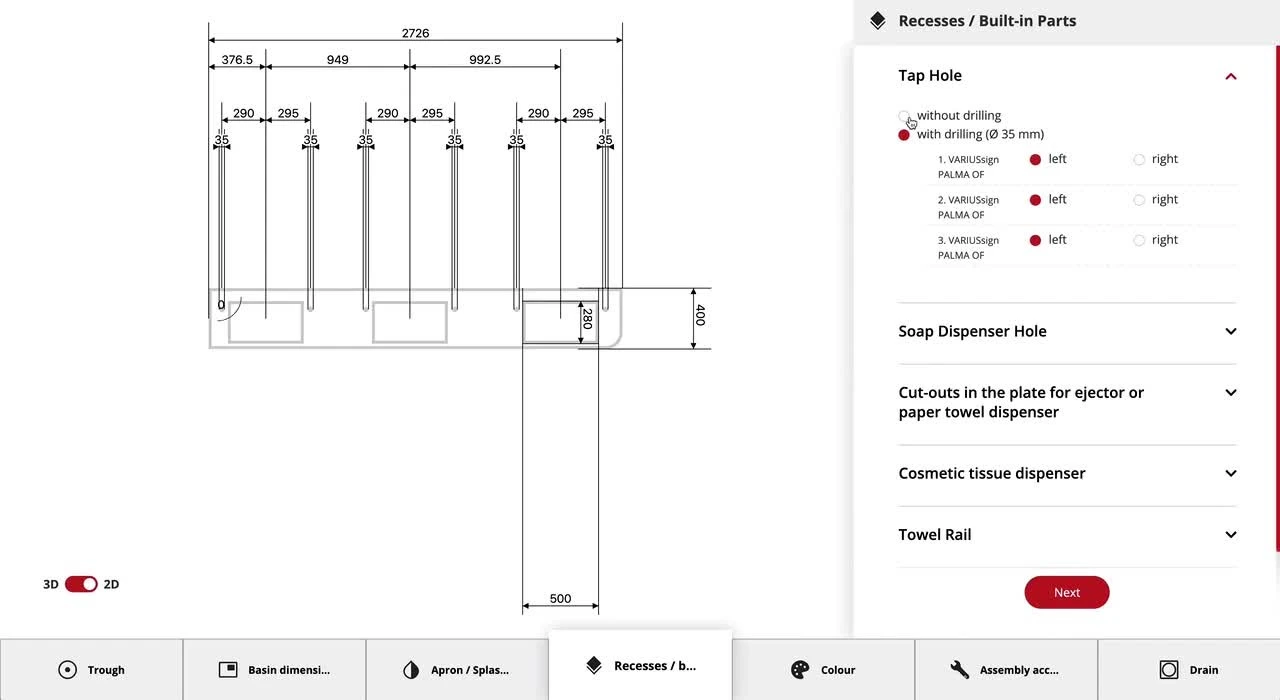
- Complementary equipmentSpray protection, apron, drilling and individual cutouts specify the function of the washstand.
- Complete optics and assemblyColor, consoles and drain accessories complete a technically coherent configuration.
A border needs a next step.
Minimum dimensions and clearances depend, among other things, on the trough selection and the mounting brackets. An impermissible combination must not end the process in an impasse. The surface must explain what can be changed: for example, increase one dimension or choose another component.
Direct manipulation and numerical input complement each other. Automatic placement takes over recurring work while the configuration remains verifiable. The interaction thus not only conveys options, but also the rules that stand behind them.
Each view has its own task.
3D: understanding spatially
The spatial representation shows the appearance and proportions of the selection. Changes are immediately apparent.
2D: Precisely check
Measures, positions and distances can be checked in a technical view and compared with the requirements of the project.
The technical drawing continues the result from the surface in offer, installation and production. Configuration data is transferred to SAP. The product thus closes a gap between an understandable selection and the internal process that makes it executable.
Behind the scenes, UX is also crucial.
The dashboard connects drafts, quote requests, offers and orders. Folders, statuses, and contextual actions help organize configurations across their lifecycle. Already transmitted configurations are blocked; responsibilities in sales can be assigned via postcode areas.
For price imports from SAP, a testable process has been designed for twelve markets: uploading files, validating data, applying changes. Missing columns, invalid prices and incomplete markets require different feedback. Currencies, validity periods and authorizations represent the operational reality.
Accompanying a product over several years.
- 2018–2019 / Concept and introductionDevelopment of the product, MVP and presentation at ISH 2019.
- 2022 / SAP S/4HANAThe connection to the enterprise software was further developed with the system migration.
- 2023 / New product lineThe product logic and its user guidance have been extended by further assortment.
- 2024 / Markets and Labour OrganizationAdditional markets, trough previews and folders extended the practical use.
From the single washstand to the entire washroom.
The enlargement concept starts with space. Planning begins with spatial form and wall dimensions in a 2D floor plan. Windows and doors determine where to place washstands, shelves and accessories.
Already configured washbasins can be transferred into the room. In the 3D view, the placement can be checked. Undo, repeat and ongoing price feedback will continue the interaction logic of the existing configurator.
The screens show a Figma concept design. The extension has not been published.
From the product idea to the coherent tool.
The original idea resulted in an internationally applicable product with more than 10,000 configurations in 30 markets and eight languages. The application combines product catalogue, decision support, sales and technical output.
For me, the case shows how closely product strategy and design go together: The right first scope makes a start possible. A clear interaction logic creates trust. And the connection to operations makes it possible to further develop the product over the years.