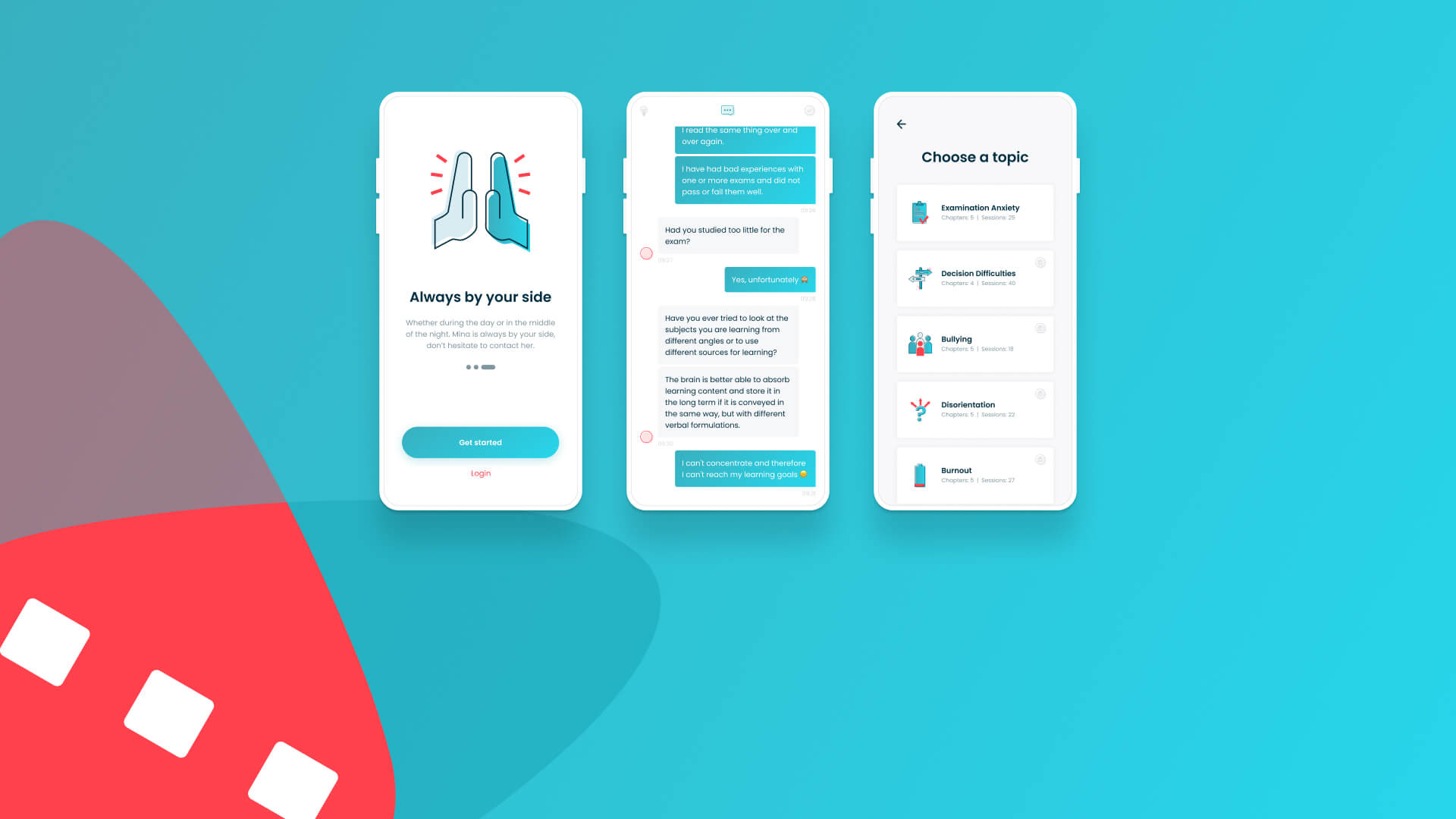
Mina brought exam coaching to AI chat and earned coverage from Tagesschau during beta.
Those who are before an exam often have a concrete concern and little time. With Mina, I have investigated how a conversation on the smartphone can provide orientation in this situation. The path led from handwritten dialogue to a closed beta to an experiment with a large language model.
What does someone need to write an exam tomorrow?
The idea for Mina came up in 2020 during the lockdown. Personal conversations fell away. At the same time, very everyday burdens remained. I was interested in the moment when someone is looking for support, but does not yet know how to describe their own cause.
Examination anxiety offered us a concrete introduction. An oral exam, a presentation, and a full learning plan generate different questions. In these situations, we were able to check how closely a digital coach has to listen before his next step in the conversation makes sense. In terms of content, the concept was based on cognitive behavioral therapy.
First understand the issue. Then write the dialogue.
I did 30 in-depth interviews. For product work, it was crucial to distinguish three questions. When is there a need for support? What would anyone tell a chatbot? And what would the person notice during the conversation that the answer fits their situation?
My task was to make a testable excerpt from the wide range of possible topics. The interviews provided the context for this decision. Whether a dialogue actually felt understandable, we then had to investigate with a usable prototype.
A link was sufficient for the first product test.
With Landbot, we built the first conversations as linked text modules. A small test circle was able to try out the dialogues via a link. So a question could be reworded or a branch changed before a team had to build a new app version.
The prototype made a peculiarity of Conversational UX visible. A single sentence can be understandable and still be in the wrong place in the conversation. For the review, the team had to play through the respective path itself. A list of shared texts would not have done this check.
How does an icon invite you to a personal conversation?
The brand had to work on the small area of an app icon. In several design rounds, we investigated how a conversation can be visually suggested. Turquoise and red gave Mina its own identity. The short name could also be used in English dialogues.
From the subject to the first answer.
The theme card in the Figma draft explains before the start what it is about and what the scope of the coaching is. The draft for exam anxiety lists five chapters and 25 sessions. Only then does the person decide whether to choose this topic.
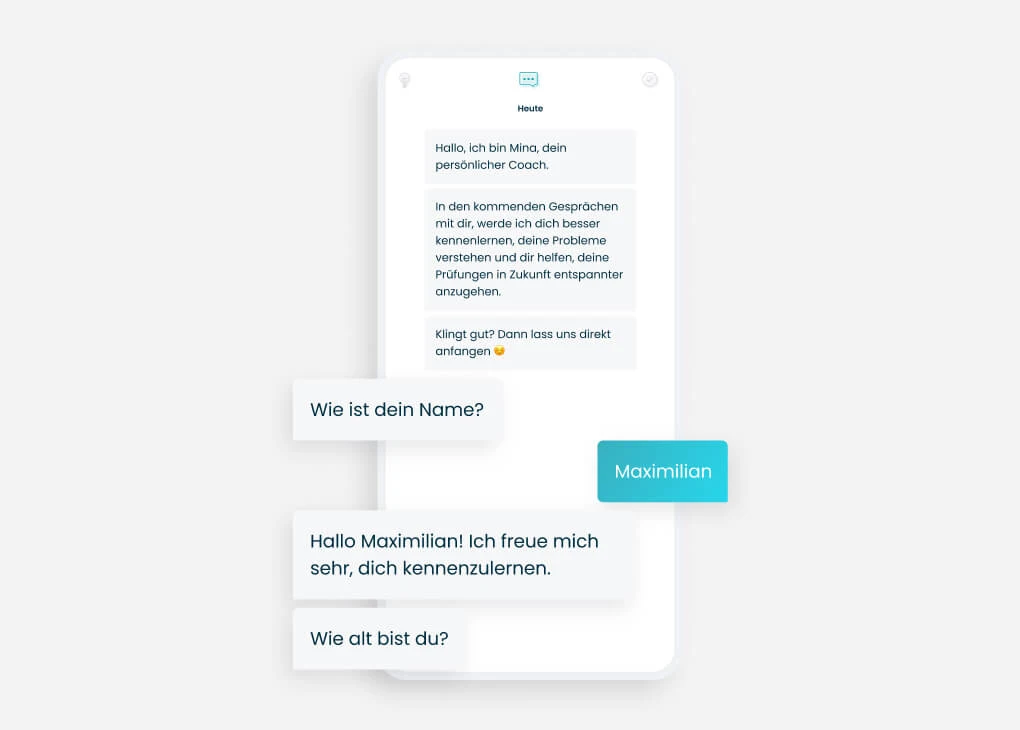
In the next screen, Mina introduces herself and explains what should happen in the conversation. This first message takes on a task that often does a tutorial in other apps. It sets expectations for the tone, process and subject of the exchange.
The table of contents complements the chat with direct navigation. Anyone practicing for a presentation can find the appropriate section specifically. For me, this was an important design decision. The conversation creates closeness, the chapter structure gives the users control over the way.
An editorial system for hundreds of pages of conversation.
The mobile application was created with React Native and AWS. The more complex product decision concerned the contents. For hundreds of pages of conversation, we needed a system in which the team could maintain texts, branches and reusable building blocks.
First of all, we wanted to connect Landbot to the app via his API. That would have saved a system change. However, when moving from the test dialog to its own interface, the interface proved to be too inflexible. We chose Botpress. The editorial team was able to visually edit dialog flows there, while the app took over the presentation.
What changes with a language model.
The app went into a closed beta with students and pupils. The focus on exam anxiety, performance pressure and learning stress kept the trial manageable. The 16 topics conceived described the possible expansion.
Later, in an LLM prototype, we investigated how freely formulated input changes the course of the conversation. In an editorial dialogue, each branch can be read and checked individually. A language model can respond differently to the same input. This also changes the task of product management. It must define which answers are appropriate in the respective context and how deviations can be detected.
With the advent of widely available language models, we have re-evaluated the original product idea and ended the further development in this form. The closed beta and the LLM prototype mark different stages of development. No clinical efficacy statement can be derived from the product tests.
What I take from Mina to other product teams.
- Test the riskiest user experience first.At Mina, this was the second or third step in the conversation. A clickable dialog could show earlier whether an answer was connectable than a ready-made start screen.
- Design editorial as part of the product.Each additional path of conversation creates work for the people who write it, review it, and later change it. Their tools therefore already belong on the table when architectural decisions are made.
- Treat a technology change as a product decision.With generative AI, expectations of a chatbot changed. This once again raised the question of which independent benefit a specialized offer creates and how this benefit can be verified.